
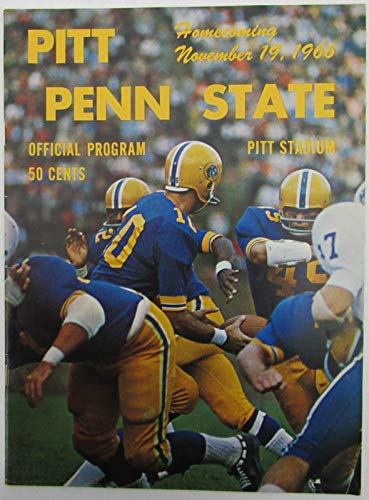
Yesterday, in front of a packed Beaver Stadium, Pitt and Penn State played what may be the last game in a 100-year old, storied rivalry for a good long while.
The game itself was everything that a rivalry game should be…a close match that came down to just a handful of plays and coaching decisions that tilted the game in one way rather than the other. My squad lost – as they have in each of the last three meetings – but it was a good game, a meaningful game, a fun game; and in the end, the result was less meaningful than the sum of all the parts.
But now we are about to embark on another hiatus. And this one (like the last one), looks like it may have some staying power. The reasons for the hiatus – which many people struggle to see – are real, and they’re multifaceted. But what is not hard to see is who pays the price, regardless of the reasons: the athletes, the students, the alumni, and the fans.
The first break in one of the country’s best college football rivalries was because of conference alignment. Pitt opted for the football-basketball combo conference, the Big East, while Penn State later joined the more football-centric conference, the Big Ten. Animosity boiled over as both sides felt betrayed, and the game went on ice for eight years before a four-year revival.
The second break, which stretched from 2001-2015, was born more out of taking advantage of a broken, money-hungry college football system than it was any lingering animosity.
Uneven 7-home, 5-road game schedules bring more money into a college football program and a town – which Penn State opts for almost exclusively.
Meanwhile, while non-conference losses don’t affect a program’s ability to win their division, it does affect national rankings. Higher rankings = more money.
Simply put, Penn State is the better of the two programs. As such, they have more to lose should the game be played. A mediocre Pitt team, geared up to play their rival, is a much tougher opponent than an equally mediocre opponent like, say, West Virginia, Syracuse, or Virginia Tech. If you’re Penn State and you win – congrats, you beat a mediocre team. If you lose – you tumble in the rankings and pay the price (financially).
The easier-said-than-done solution here: Pitt just needs to get better. While the game itself is always a hit, if Pitt were regularly ranked, this game would look much more attractive on Penn State’s schedule from a ranking perspective. The problem is that since the demolition of Pitt Stadium, the program has been mired in a state of mediocrity that nothing short of new construction may be able to solve. If Pitt is not a formidable opponent, any future scheduling of the rivalry is, unfortunately, going to be more Penn State throwing their in-state foes a bone than anything else.
The athletes hate the hiatus. The students hate the hiatus. The alumni and fans hate the hiatus. But bragging rights cannot be converted into real world dollars and cents – which means despite being a state-run, non-profit university, Penn State simply has more to lose and less to gain in booking this game anymore.
As one of the aforementioned losers in this ultimate decision, I hate it with a fiery passion – despite fully understanding it. And I fear that should this hiatus linger for another decade-plus, this once-storied rivalry may no longer be able to sustain its rivalry status. As those who remember the late-November, frigid clashes of national powerhouse programs continue to age and pass on, the stories and the legend of the series will unfortunately pass on with them. At that point, those of us caught in the middle will sound like lunatics, referring to games we were too young to have seen and animosity that we weren’t actually a part of – hopelessly clinging to a burning candle that is really nothing more than a smoking wick at this point.
Here’s to hoping against hope that someone, at some point, realizes that there is still intangible value in bragging rights and tradition…because at the end of the day, college football is supposed to be about the athletes, the students, the school – not money.