Overtime Points – A Broken System

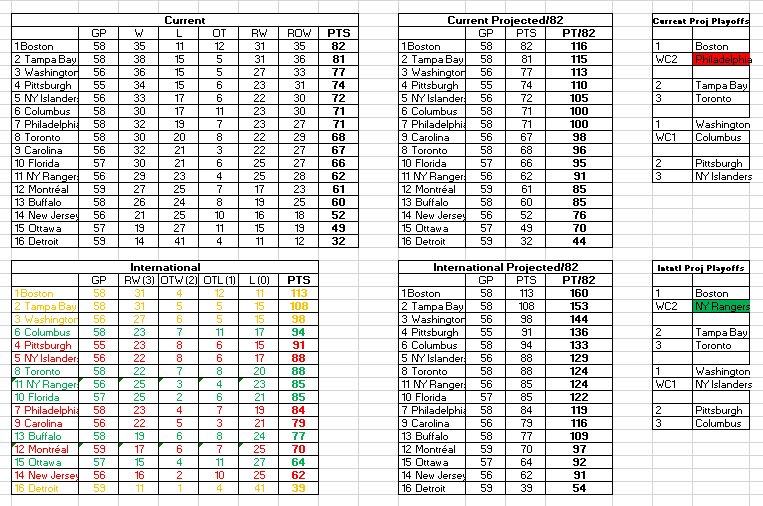
Over the past few years, I’ve had countless discussions about the broken point system in the NHL. By and large, I think it affects the way the game is played, particularly later in the season when teams in the hunt can’t afford to give away points – so they play a conservative third period. Naysayers point to Reddit posts claiming, “it all comes out in the wash.” Well, if this season plays out as expected, one major metropolitan city will be very happy with the current point system, while another is lamenting it.

Note, I bleed orange and black, so I’ll happily take this year’s gift of a playoff appearance (should it end the way it’s projected). But the Ranger faithful likely will not share my enthusiasm. See the chart below:

From the 11-seed to the 8-seed, the NY Rangers would be the biggest beneficiary of a system change

The End of an Era

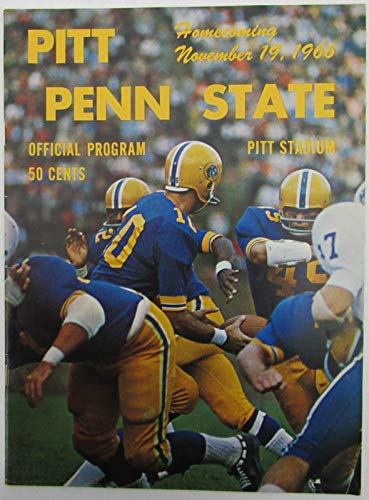
Image result for pitt penn state

Yesterday, in front of a packed Beaver Stadium, Pitt and Penn State played what may be the last game in a 100-year old, storied rivalry for a good long while.

The game itself was everything that a rivalry game should be…a close match that came down to just a handful of plays and coaching decisions that tilted the game in one way rather than the other. My squad lost – as they have in each of the last three meetings – but it was a good game, a meaningful game, a fun game; and in the end, the result was less meaningful than the sum of all the parts.

But now we are about to embark on another hiatus. And this one (like the last one), looks like it may have some staying power. The reasons for the hiatus – which many people struggle to see – are real, and they’re multifaceted. But what is not hard to see is who pays the price, regardless of the reasons: the athletes, the students, the alumni, and the fans.

The first break in one of the country’s best college football rivalries was because of conference alignment. Pitt opted for the football-basketball combo conference, the Big East, while Penn State later joined the more football-centric conference, the Big Ten. Animosity boiled over as both sides felt betrayed, and the game went on ice for eight years before a four-year revival.

The second break, which stretched from 2001-2015, was born more out of taking advantage of a broken, money-hungry college football system than it was any lingering animosity.

Uneven 7-home, 5-road game schedules bring more money into a college football program and a town – which Penn State opts for almost exclusively.

Meanwhile, while non-conference losses don’t affect a program’s ability to win their division, it does affect national rankings. Higher rankings = more money.

Simply put, Penn State is the better of the two programs. As such, they have more to lose should the game be played. A mediocre Pitt team, geared up to play their rival, is a much tougher opponent than an equally mediocre opponent like, say, West Virginia, Syracuse, or Virginia Tech. If you’re Penn State and you win – congrats, you beat a mediocre team. If you lose – you tumble in the rankings and pay the price (financially).

The easier-said-than-done solution here: Pitt just needs to get better. While the game itself is always a hit, if Pitt were regularly ranked, this game would look much more attractive on Penn State’s schedule from a ranking perspective. The problem is that since the demolition of Pitt Stadium, the program has been mired in a state of mediocrity that nothing short of new construction may be able to solve. If Pitt is not a formidable opponent, any future scheduling of the rivalry is, unfortunately, going to be more Penn State throwing their in-state foes a bone than anything else.

The athletes hate the hiatus. The students hate the hiatus. The alumni and fans hate the hiatus. But bragging rights cannot be converted into real world dollars and cents – which means despite being a state-run, non-profit university, Penn State simply has more to lose and less to gain in booking this game anymore.

As one of the aforementioned losers in this ultimate decision, I hate it with a fiery passion – despite fully understanding it. And I fear that should this hiatus linger for another decade-plus, this once-storied rivalry may no longer be able to sustain its rivalry status. As those who remember the late-November, frigid clashes of national powerhouse programs continue to age and pass on, the stories and the legend of the series will unfortunately pass on with them. At that point, those of us caught in the middle will sound like lunatics, referring to games we were too young to have seen and animosity that we weren’t actually a part of – hopelessly clinging to a burning candle that is really nothing more than a smoking wick at this point.

Here’s to hoping against hope that someone, at some point, realizes that there is still intangible value in bragging rights and tradition…because at the end of the day, college football is supposed to be about the athletes, the students, the school – not money.

Haze for Days

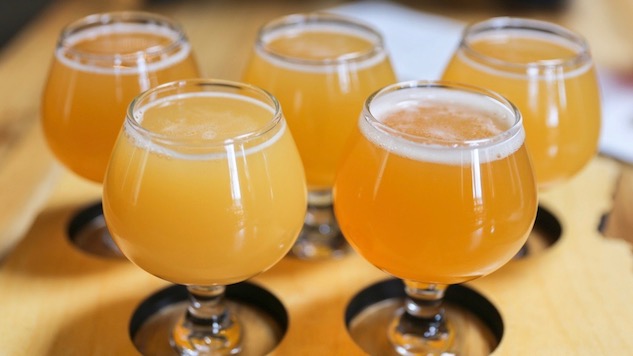
We’re now far enough removed from 2017 to begin looking back and recognizing some of the trends we bore witness to and/or participated in. Within the craft beer world, drinkers are always looking for the latest and greatest thing. Brewers do their best to stay ahead of the curve, but none can be sure where the collective pallets are heading. In 2017, the competition to become the “it” beer style was a two-horse race between sweet, adjunct-heavy stouts and the hazy IPA. If we’re being honest, though, the race was never particularly close. 2017 was the Year of the Haze.

For those not in the know, these hazy beers, called New England IPA’s, are basically unfiltered single or double IPA’s with a higher viscosity (denser, heavier) and a juicy taste. To achieve the signature hazy look, which will vary from slightly cloudy to totally opaque, brewers use varying degrees of high-protein grains, select yeast strains, and other techniques.

Breweries from the Northeastern corridor have been highly acclaimed for some years now, but 2017 was truly the year of their come-uppance. The NE IPA, made famous by craft beer industry heavy-hitters like Treehouse, Hill Farmstead and Trillium, took the country by storm. It seems every craft brewer nation-wide has jumped on the bandwagon, producing their own version of the NE IPA.

“Hipsters, man,” the bartender, brewer, and part owner of Modern Times in San Diego told me in October. “They want their hazy beers, and if we don’t have a hazy beer to sell them, the place down the street does…and they’ll go there instead.”

Modern Times has, over the years, become a San Diego staple. As such, you’d expect big, bold, bitter West Coast style IPA’s to be aplenty. And yet, in October 2017, eight of the sixteen taps at the Point Loma brewery were filled with varying versions of the hazy IPA. Some were simply unfiltered, hazier-than-normal IPA’s. Others were true, juice-like NE IPA’s. The rest fell somewhere in the middle.

The NE IPA was not invented in 2017, but it was largely overlooked by the beer community nationwide until recently. Living in a social media driven, Facebook-Official world, I suppose it’s fair to say the NE IPA “officially” became a distinct style in May 2017. This is when Beer Advocate, one of the top websites/publishers in the craft beer industry, posted an article making the declaration that the NE IPA was, in fact, its own unique style. Previously, most in the industry lumped these beers into the “American IPA” category, which did a disservice to both these hazy beers and the more traditional IPA’s for comparison’s sake.

“Consumers have spoken, brewers have embraced it, and everyone already uses the name,” the article stated. “So like it or not, the New England India Pale Ale is a style, and one that you’re going to see much more of as brewers continue to jump on the hazy hype train.”

For further evidence, a quick glance at the beer rating app Untapp’d was in order. Even though they’re still lumped into the American IPA category on the app, the list displaying the top rated beers currently in production shows that the NE IPA is currently lapping the field. Currently, eight of the top fifteen rated beers globally are hazy IPA’s, with Treehouse Brewing dominating the list. As Beer Advocate stated, the consumers truly have spoken.

The calendar has turned to 2018, so it’s prudent to ask the question: what’s the next “it” beer? I don’t foresee the hazy IPA going away anytime soon. Its presence has been established and it will likely continue to claim shelf and tap space alongside the IPA, the stout, and so on for the foreseeable future. But where will the trends take us? Will other beer styles, like pilsner or saison, get the haze treatment? Or will an older, neglected style – I’m looking at you, lager – have a renaissance of sorts and reclaim its spot among the beer hierarchy? Unfortunately, I don’t have Biff’s Sports Almanac and can’t see the future, so your guess is as good as mine…but I’m eager to taste the answer.

Mission Accomplished

Congratulations to the Philadelphia Eagles.  Despite a season filled with [injury-related] adversity, the players and coaches managed to bring the Lombardi Trophy home to Philadelphia for the first time.  Millions of people across the Delaware Valley can now cross “Super Bowl Win” off of their bucket list.  For that we thank you, Philadelphia Eagles.

The aftermath of the win, namely the manner in which many fans celebrated, was almost as big a story as the win itself.  Videos circulated of former WNBA star Dawn Staley verbally unloading the chip from her shoulder, while others of Kobe Bryant’s fatherly-subdued reaction warmed many hearts.  Average Joe fans took to the streets, flooding the intersections around City Hall and Frankford & Cottman alike.  There was screaming, yelling, hugs, kisses, fireworks, and so forth (and less arrests/destruction than in Boston…another win for Philadelphia).

At home, with just a small collection of family around me, I witnessed a lot of screaming and a lot of hugs (father and son, father and daughter, etc).  So what did I do?  Surprising even to myself, I mostly celebrated internally.

I am not a quiet guy.  I am not a passive guy.  I emphatically high five for every touchdown.  I yell at the screen when Big V misses a block.  I screamed and nearly woke my daughter two floors above me when Brandon Graham forced Brady to fumble.  And yet, when the clock hit zero…I backed against the wall, fist-pumped to myself, and breathed a sigh of relief.

Since that moment, I’ve taken some time to reflect on the reaction.  I find it odd and kind of out of character, which makes it compelling to me.

As an active adult athlete (yes, they’re beer leagues, so sue me), I’ve won a handful of championships over the years.  Looking back on those wins, while my teammates are throwing their gloves in the air and running to hug one another around the pitcher’s mound…I’m fist-pumping and breathing a sigh of relief.

When the Phillies won the World Series in 2008, my friends at the viewing party I attended lost their minds.  It was, after all, the first pro sports championship any of us had experienced in our lifetimes.  They piled onto one another in the middle of the living room as if Brad Lidge was under that very pile.  They ran outside and sprayed beer and soda bottles on one another, jubilantly hugging, kissing, yelling.  Me?  I fist-pumped, breathed a sigh of relief, and observed.

So…I’ve examined the wins.  What about the losses?

When Patrick Kane snuck the puck inside the left post in Game 6 of the 2010 Stanley Cup Finals, I was in the building.  My seat was about 100 feet above the scene of the crime.  Fans around me cried.  Others cursed and began placing blame.  Regardless, most stayed to watch the Stanley Cup be awarded.  Me?  I left my seat and sank down along the wall in the corridor.  Alone.

When those same beer league teams lose in the playoffs or championship and the team rallies together to pick one another up (or put each other down, depending on the team), I keep my distance.

All of this leads me to the question of why.  Why does someone so social, so passionate, and so invested withdraw and celebrate/lament internally?  Have I just invested SO MUCH physically and/or emotionally that I have nothing left to give?  My curiosity has certainly been piqued.  I think some serious research is in order.

Stay tuned for part two (eventually).

Welcome to the Jungle

Hello, and welcome to my blog.  I appreciate that you’ve taken time out of your day to take a look-see.

I plan to keep this blog fairly active; a posting every week or two is the tentative plan.  Of course, life likes to take your plans, crumble them up and toss them out the window, so, we’ll see how that goes.

This blog will surely not be formal.  Topics will vary from post to post.  Some may be more professional in nature.  Others…not so much.  Some may even be simple stream-of-consciousness rambling.  Some of the greatest ideas start that way, so why the heck not?

Again, I appreciate that you’ve taken the time to check in and I look forward with providing you with reading material in the very near future!