
Haze for Days
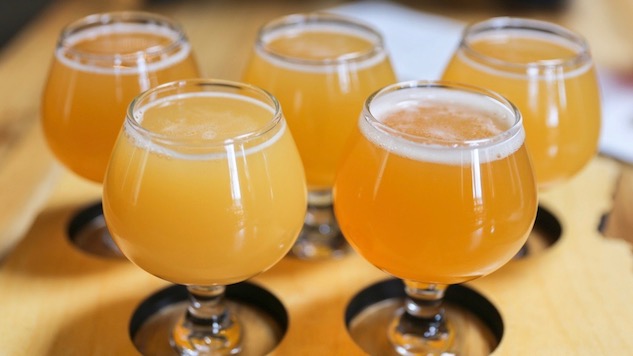 We’re now far enough removed from 2017 to begin looking back and recognizing some of the trends we bore witness to and/or participated in. Within the craft beer world, drinkers are always looking for the latest and greatest thing. Brewers do their best to stay ahead of the curve, but none can be sure where the collective pallets are heading. In 2017, the competition to become the “it” beer style was a two-horse race between sweet, adjunct-heavy stouts and the hazy IPA. If we’re being honest, though, the race was never particularly close. 2017 was the Year of the Haze.
For those not in the know, these hazy beers, called New England IPA’s, are basically unfiltered single or double IPA’s with a higher viscosity (denser, heavier) and a juicy taste. To achieve the signature hazy look, which will vary from slightly cloudy to totally opaque, brewers use varying degrees of high-protein grains, select yeast strains, and other techniques.
Breweries from the Northeastern corridor have been highly acclaimed for some years now, but 2017 was truly the year of their come-uppance. The NE IPA, made famous by craft beer industry heavy-hitters like Treehouse, Hill Farmstead and Trillium, took the country by storm. It seems every craft brewer nation-wide has jumped on the bandwagon, producing their own version of the NE IPA.
“Hipsters, man,” the bartender, brewer, and part owner of Modern Times in San Diego told me in October. “They want their hazy beers, and if we don’t have a hazy beer to sell them, the place down the street does…and they’ll go there instead.”
Modern Times has, over the years, become a San Diego staple. As such, you’d expect big, bold, bitter West Coast style IPA’s to be aplenty. And yet, in October 2017, eight of the sixteen taps at the Point Loma brewery were filled with varying versions of the hazy IPA. Some were simply unfiltered, hazier-than-normal IPA’s. Others were true, juice-like NE IPA’s. The rest fell somewhere in the middle.
The NE IPA was not invented in 2017, but it was largely overlooked by the beer community nationwide until recently. Living in a social media driven, Facebook-Official world, I suppose it’s fair to say the NE IPA “officially” became a distinct style in May 2017. This is when Beer Advocate, one of the top websites/publishers in the craft beer industry, posted an article making the declaration that the NE IPA was, in fact, its own unique style. Previously, most in the industry lumped these beers into the “American IPA” category, which did a disservice to both these hazy beers and the more traditional IPA’s for comparison’s sake.
“Consumers have spoken, brewers have embraced it, and everyone already uses the name,” the article stated. “So like it or not, the New England India Pale Ale is a style, and one that you’re going to see much more of as brewers continue to jump on the hazy hype train.”
For further evidence, a quick glance at the beer rating app Untapp’d was in order. Even though they’re still lumped into the American IPA category on the app, the list displaying the top rated beers currently in production shows that the NE IPA is currently lapping the field. Currently, eight of the top fifteen rated beers globally are hazy IPA’s, with Treehouse Brewing dominating the list. As Beer Advocate stated, the consumers truly have spoken.
The calendar has turned to 2018, so it’s prudent to ask the question: what’s the next “it” beer? I don’t foresee the hazy IPA going away anytime soon. Its presence has been established and it will likely continue to claim shelf and tap space alongside the IPA, the stout, and so on for the foreseeable future. But where will the trends take us? Will other beer styles, like pilsner or saison, get the haze treatment? Or will an older, neglected style – I’m looking at you, lager – have a renaissance of sorts and reclaim its spot among the beer hierarchy? Unfortunately, I don’t have Biff’s Sports Almanac and can’t see the future, so your guess is as good as mine…but I’m eager to taste the answer.